This exhibition uses headphones to immerse the listener in a 3D experience:
http://www-users.york.ac.uk/~dtm3/RS/RSweb.htm
Even though the surround sound headphones only utilise one cue for direction (HRTF) they would seem to be the lesser choice compared to the full speaker arrangement. However, headphones do offer a medium in which pretty much all the visitors will be familiar with and also the more likely chance of concentration upon the audio without background interference.
Thursday, 11 April 2013

Wednesday, 10 April 2013
Stereo Definition
Alan Blumlein, who worked at EMI in England was responsible for the first developments in stereo. In 1931 Blumlein filed a patent where he describes a two-channel(speaker) method of sound reproduction, this patent was accepted in 1933. It also covers some other developments in audio and television technology such as, Binaural recording and the Blumlein Pair; a stereo microphone array consisting of the matched microphones with figure-of-eight polar patterns positioned 90 degrees from each other:

 Blumlein's drawing of Stereo Speaker System

Blumlein Pair
http://en.wikipedia.org/wiki/File:Blumlein_-Stereo.png
accessed: 10/04/13
Blumlein describes in patent 394,325 (entitled: Improvements in and relating to Sound-transmission, Sound-recording and Sound-reproducing Systems) a method of reproducing sound with two speakers which is known to us today as Stereo:

http://www.doramusic.com/patents/394325.htm
Accessed: 10/04/13
The same year that Blumlein's patent was accepted, 1933, there were other developments in stereo reproduction in the U.S by Bell laboratories. They transmitted audio by high-bandwidth telephone lines from the Academy of Music in Philadelphia to the Constitution Hall in Washington DC.
Bell Labs described a 3-channel system consisting of left, centre and right speakers. This speaker system is now used today in the 5.1 standard format. They concluded that an infinite number of loudspeakers is preferable, however the left, right, centre set up was a "practical" approach to representing and infinite number of speakers.
A conductor named Leopold Stokowski operated 3-channel level and tone controls for the 3-channel system in Washington DC, while the audio was transmitted from the Philadelphia. A curtain was covering the stage in washington DC and to the crowds amazement, when the curtains were raised they were not watching an orchestra but rather a set of 3 loudspeakers.
References:
PATENT SPECIFICATION
Application Date: Dec. 14, 1931. No. 394,325
Complete Left: Nov. 10, 1932.
Complete Accepted: June 14, 1933.
-------------------------
PROVISIONAL SPECIFICATION
Improvements in and relating to Sound-transmission, Sound-recording and Sound-reproducing Systems.
Alan Blumlein
Holman Tomlinson, 2008,
Surround Sound Up and Running,
Second Edition
Monday, 18 March 2013
Differences in recording for surround
The recording stage is the first stage after
composition and is when an artist’s song is first introduced to the studio. At
this point the artist should have a clear idea of what each piece of
instrumentation will be doing in the music. This is the chance to experiment
with these ideas now that it is possible to listen back to their artwork. This
production stage should result in all of the instrumentation being recorded and
structured to the artist and sound engineer’s satisfaction; no new
instrumentation is normally added after this stage.
So what does the recording stage involve? The
recording stage involves the capturing of the artists music via microphone or
direct input to the mixing desk. Different sound engineers will utilise
different methods while recording and it is important to note that there are no
set rules to the production of music, it is completely subjective. Although the
creation of music is a subjective thing, recording techniques and methods have
been devised specifically for the capturing of sound in stereo and 5.1 Surround
Sound and these methods differ between the two reproduction systems.
The invention of the stereo system of course saw to
the invention of stereo recording techniques. Stereo recording techniques
normally involve two microphones spaced or angled in a specific way towards the
sound source. The signal from these microphones is then sent to the mixing desk
where they are panned to the corresponding left or right speaker e.g. left
microphone panned to left speaker, right microphone panned to right speaker. Stereo
microphone techniques create the impression of space and the directionality of
sound sources; this is due to inter-aural time differences and inter-aural
intensity differences, the same way that human hearing localises sound. It is
important to note that during stereo recording not all techniques use two
microphones such as, close micing, which is where one microphone is place close
to the sound source and then recorded and panned appropriately.
All Stereo techniques can be applied in the
recording stage of 5.1 Surround sound music production, however panning methods
can differ as there are extra centre and rear channels. Similarly to the stereo
reproduction system, 5.1 surround sound has it’s own microphone techniques,
some of which were adapted from stereo techniques. Surround microphone
techniques can utilise anything from two to six microphones again with specific
spacing’s or angles.
Friday, 15 March 2013
Quadrophonic Era
The Quadrophonic system relies of four loudspeakers place right, left, right rear and left rear. This System was to be introduced to the market place at the start of the 1970's and died out within a decade:
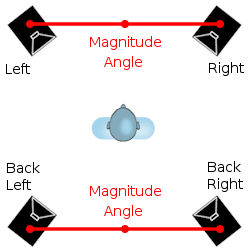
Quadrophonic System
http://people.xiph.org/~xiphmont/surround/demo.html
Accessed: 16/04/13
In order to begin talking about the Quadrophonic Era we must first know the difference between Matrix Encoded multichannel audio and Discrete multichannel audio:
Matrix Encoded:
Matrix encoded multichannel audio is where the surround and centre channels are created by using combinations of the original left and right stereo channels, otherwise known as Upmixing. Seen as the centre and surround channels will include information that is also in the front left and right channels, matrix encoded multichannel audio cannot isolate sounds to the surround channels.
Discrete:
Discrete multichannel audio is where the centre and surround channels are encoded on separate streams rather than being matrixed from a stereo signal. Discrete audio allows sounds to be isolated completely to the surround and centre channels creating better directionality and localisation.
The Quad Era saw many different engineers design different matrixes that would help reproduce 4 channels of audio from a Vinyl disc, such as Peter Scheiber's 4-2-4 matrix that allowed 4 channels to be compressed into 2 and then restored to 4 again using wide band phase-shift networks in the encoding and decoding process. One of Scheiber's demonstrations of his matrix to CBS executives caught the interest of Benjamin B. Bauer, who then went on to design the SQ (stereo-quad) matrix with the help of the CBS Laboratories. Bauer claimed that his matrix had better spatial attributes and compatibility with stereo and monophonic playback and it was this invention that earned him his nick name of the "Quad Father", however it was not long before many other matrixes were invented such as the, QMX matrix from Duane Cooper, QS matrix from the Sansui Corporation and Ambisonics from Michaul Gerzon in the UK.
Now that there were so many different quadrophonic matrixes available, it wasn't the question of which matrixes would become the standard, but whether either matrix or discrete surround audio would become the standard for multichannel audio. The invention of the CD-4 record from the JVC Corporation and RCA Records saw the end of this debate as it allowed the reproduction of discrete audio.
Although the Quadrophonic Era saw to many new inventions such as multichannel audio matrixes, it had failed to become a great success. There are many different speculations as to why the quad system had failed such as, there were too many competing formats for the music dealers, and they would have to provide all of their products in three different formats, stereo record, cassette tape and quad record, which didn't see any extra profit to the dealers and record companies. Other reasons for the Quad Systems failure were that the market was not warming to the idea of having two extra loudspeakers in there listening space and also record producers were not able to exploit the medium as they believe it:
"locked them into rigid four-cornor reproduction"
Emil Torick
Highlights in the History of Multichannel Surround
Audio Engineering Society Journal, Vol.46, No. 1/2
January/February 1998
Emil Torick also describes how the Quad Era failed in and interview with the AES:
http://www.youtube.com/watch?v=rJhC7VchDuo
accessed: 17/04/13
Having discussed the reasons for the Quad System's failure in the music industry, it is interesting to relate this to the 5.1 Surround Sound System, which is now a standardised format. The 5.1 System is hugely popular and the standard for film and becoming more and more popular in the gaming industry with the invention Surround Sound headphones. However it's uses in the Music Industry has been more elusive, is this because of the same reason as the Quad Era? Do record companies not produce 5.1 music material because it would not increase profits? Is Stereo then the standard format for the music industry?
References:
Emil Torick
Highlights in the History of Multichannel Surround
Audio Engineering Society Journal, Vol.46, No. 1/2
January/February 1998
http://www.youtube.com/watch?v=rJhC7VchDuo
accessed: 17/04/13
Holman Tomlinson, 2008,
Surround Sound Up and Running,
Second Edition
Wednesday, 13 March 2013
Exposition 3
This sound exhibition in singapore talks about immersing yourself in sound and has different interesting things in which people can interact with:
http://www.science.edu.sg/exhibitions/Pages/SoundExhibition.aspx
As part of my project i believe the best way to portray my work is if the visitor can interact with it and possibly even change parts of it to their liking. One way in which i could do this is if i provide a mixer in which the visitor can alter the levels of each individual speaker channel in the surround system: allowing them to hear parts of the music in a way that they wouldn't normally be able to do by soloing individual channels.
http://www.science.edu.sg/exhibitions/Pages/SoundExhibition.aspx
As part of my project i believe the best way to portray my work is if the visitor can interact with it and possibly even change parts of it to their liking. One way in which i could do this is if i provide a mixer in which the visitor can alter the levels of each individual speaker channel in the surround system: allowing them to hear parts of the music in a way that they wouldn't normally be able to do by soloing individual channels.
Thursday, 28 February 2013
Exposition Ideas 2
This cool proposal for a permanent sound exhibition looks to absorb unwanted sounds of over running water at Diglis Weir in Worcester:
http://www.liminal.org.uk/cochlea_unwound/
http://www.liminal.org.uk/cochlea_unwound/
Thursday, 21 February 2013
5.1 Surround Sound Definition
5.1 Surround Sound system was standardised and named for film in 1987, it is standard format for multichannel sound in the mass market today. The 5 stands for the 5 speakers/channels placed left, centre, right, left surround and right surround. The 0.1 speaker/channel is for Low-frequency Enhancement also known as a Subwoofer, this speaker is for low frequencies only with a greater headroom of 10dB than the other five speakers/channels.

http://en.wikipedia.org/wiki/File:5-1-surround-sound.svg
accessed 10/04/13
The LFE channel or subwoofer is often placed to the left or right of the centre channel; placement of the LFE/sub is not as important as the other 5 main channel because it is dedicated to only low-end frequencies which diffract more freely than higher frequencies.
References:
Holman Tomlinson, 2008,
Surround Sound Up and Running,
Second Edition
Friday, 15 February 2013
Personal Skills and Developement
Throughout this project project there are different skills and areas on which i would like to personally expand. I have previous experience working with 5.1 audio but not for purely music reproduction but audio that has accompanied visuals. I do have a fair amount in mixing and mastering music with a number of artists from different music genres, however this is for the stereo medium. Firstly i must set myself a few goals throughout this project to widen my knowledge and skills of 5.1 music production, not necessarily the recording side because i can source already published stereo material that i can remix in 5.1 surround sound but the mixing and mastering stages:
- Broaden knowledge of the mixing and mastering stages of 5.1 music production.
- Learn how to exploit the 5.1 mediums attributes to their full potential in remixing source material.
- Develop investigative skills into cultural aspects relating to music reproduction.
Thursday, 14 February 2013
Exposition Ideas
One of the main problem that i will occur during putting together my exposition comes from the fact that i am presenting surround sound material. Now the surround sound system exploits the same cues that humans use to determine direction of sound sources. The 5.1 speaker system uses all three, while surround headphones only utilise one, which is head related transfer function. So there has to be a choice made wether to present my material using a 5.1 speaker arrangement or 5.1 headphones.
The basis of this exhibition is all around headphones and how the visitors can interact with the artwork with their own unique listening experience:
http://www.soundandmusic.org/projects/magnetic-consumer-christina-kubisch
The basis of this exhibition is all around headphones and how the visitors can interact with the artwork with their own unique listening experience:
http://www.soundandmusic.org/projects/magnetic-consumer-christina-kubisch
Friday, 1 February 2013
Live Event Media Evaluation and Change in Project Concept
Since the last post there has been a change in the project concept. After Evaluating the recordings that were taking place in Dukes Corner and also the recordings of Rhuari Campbell, i found that the difference between the Upmixing and Microphone Array techniques was minimal. I believe the reasons for this are a follows:
1. The lack of a large audience made it difficult to create recordings that contained a good enough amount of audible crowd noise. This is one of the main aspects of live music recordings that create a sense of listener immersion; so that the listener feels like they are in the crowd of the original event.
Lack of crowd = Lack of sound sources to create better sense of directionality and localisation.
2. Compromised microphone placement in the Dukes Corner event had undesired effect on the mix.
The microphone array was supposed to be placed as close to the crowd as possible (ideally in the middle), however this was not possible due to the lack of outputs on the venues mixing desk to record line outs from the DJ's mixing decks. In light of this i decided to place the array behind the DJ to create the mix from his perspective. However due to the lack of people at the event the array was no longer capturing enough crowd ambience but instead only captured room ambience and reverberation.
3. Time scale at this point i think became a huge factor, after all at this point i was half way through my project and i would have to now re-record events and these events would also have to a large crowd to gain mixes that would be suitable for testing.
4. I believe that the whole project concept wasn't that strong as most live event recordings are not completely audio based but most of the time include visuals for DVD and Television broadcast purposes. A large part of reproducing live events is obviously in the recording of the audio, however visuals also place a huge part in event reproduction.
New Concept:
It is for these reason that i decided at this point to change the project concept to a more stronger/solid idea. While carrying out research i came across many references to 5.1 Surround Sound and it's uses in the Film and Games Industry, however not much in the way of it's uses in the Music Industry:
"In modern times we see it (Surround sound) firmly established in applications accompanying a picture for movies and television, but in other areas such as purely for music reproduction broad success has been more elusive. However using history as a guide to the future there may well be a broader place for surround music in coming years"
Aim:
An investigation into the listener preference between stereo and 5.1 surround sound music. This study is purely investigating the listener preference between the two playback formats' uses in music reproduction.
Objectives:
1. Define the main differences between stereo and 5.1 surround music production.
2. Produce 5.1 Surround Sound mixes of two pieces of music from contrasting genres.
3. Test the Listener Preference between the Surround Sound mix and the original Stereo mix of the two contrasting pieces of music.
4. Produce a questionnaire to find out how people currently purchase, access and playback their music.
1. The lack of a large audience made it difficult to create recordings that contained a good enough amount of audible crowd noise. This is one of the main aspects of live music recordings that create a sense of listener immersion; so that the listener feels like they are in the crowd of the original event.
Lack of crowd = Lack of sound sources to create better sense of directionality and localisation.
2. Compromised microphone placement in the Dukes Corner event had undesired effect on the mix.
The microphone array was supposed to be placed as close to the crowd as possible (ideally in the middle), however this was not possible due to the lack of outputs on the venues mixing desk to record line outs from the DJ's mixing decks. In light of this i decided to place the array behind the DJ to create the mix from his perspective. However due to the lack of people at the event the array was no longer capturing enough crowd ambience but instead only captured room ambience and reverberation.
3. Time scale at this point i think became a huge factor, after all at this point i was half way through my project and i would have to now re-record events and these events would also have to a large crowd to gain mixes that would be suitable for testing.
4. I believe that the whole project concept wasn't that strong as most live event recordings are not completely audio based but most of the time include visuals for DVD and Television broadcast purposes. A large part of reproducing live events is obviously in the recording of the audio, however visuals also place a huge part in event reproduction.
New Concept:
It is for these reason that i decided at this point to change the project concept to a more stronger/solid idea. While carrying out research i came across many references to 5.1 Surround Sound and it's uses in the Film and Games Industry, however not much in the way of it's uses in the Music Industry:
"In modern times we see it (Surround sound) firmly established in applications accompanying a picture for movies and television, but in other areas such as purely for music reproduction broad success has been more elusive. However using history as a guide to the future there may well be a broader place for surround music in coming years"
Holman Tomlinson, 2008,
Surround Sound - Up and Running, Second Edition
It is for this reason that i am changing my project concept, to focus on how and why 5.1 surround sound has became almost a standard format for the Film Industry and is becoming more popular in the Games Industry, with different surround systems such as headphones dedicated for purely gaming purposes. But however stereo is still the standard format for the music industry and not much in the way of surround audio is available purely for music reproduction. I have produced a new aim and set of objectives which are as follows:
Aim:
An investigation into the listener preference between stereo and 5.1 surround sound music. This study is purely investigating the listener preference between the two playback formats' uses in music reproduction.
Objectives:
1. Define the main differences between stereo and 5.1 surround music production.
2. Produce 5.1 Surround Sound mixes of two pieces of music from contrasting genres.
3. Test the Listener Preference between the Surround Sound mix and the original Stereo mix of the two contrasting pieces of music.
4. Produce a questionnaire to find out how people currently purchase, access and playback their music.
Subscribe to:
Posts (Atom)